




THE BIG IDEA
The future cannot be predicted. It can only be prepared for.
The organizations that thrive through disruption are not the ones with the best forecasts. They are the ones with teams so high in trust, so low in friction, and so comfortable with experimentation that they perform through whatever the future actually delivers.
Blueprint to the Future gives leaders the tools to build exactly that.
keynote description
It is a practical guide to building future-ready teams. Whether it’s next week’s weather or the yet-to-be-created technology that is sure to change how we work, the future is truly impossible to predict. And while the trends, charts, and forecasts are interesting, the organizations investing most heavily in prediction are often not the ones performing best. The shift that matters is moving from trying to anticipate what the future looks like to building resilient teams that can navigate whatever the future actually brings.
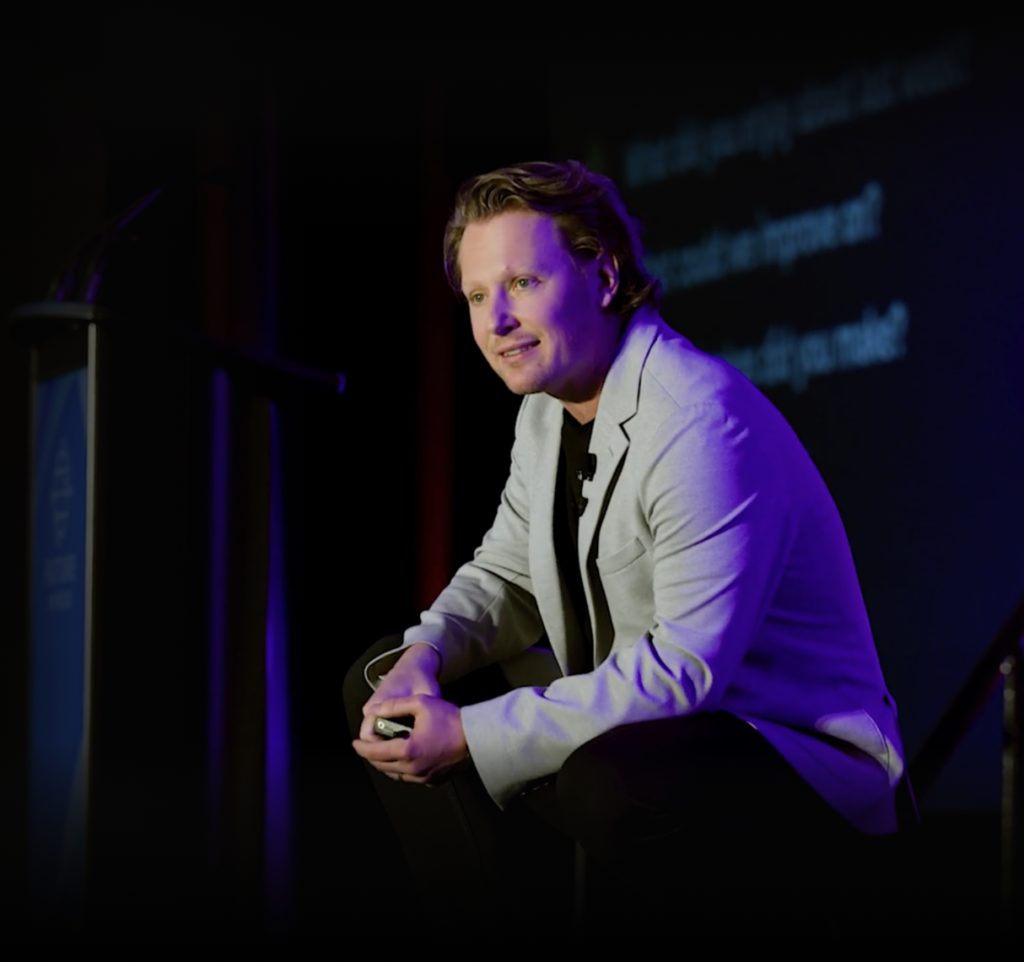
In this engaging, insight-filled, and actionable presentation, workplace culture and leadership expert Eric Termuende delivers a customized, research-backed blueprint that has helped thousands of category-leading teams build trust, remove friction, and create a culture of experimentation. Drawing on the experiences of industry leaders, icons, and trailblazers from around the world, Eric shows what these three pillars look like in practice: trust as the operating currency of every high-performing team, friction as the invisible barrier between your people and their best work, and experimentation as the psychological safety to test, fail, and iterate fast.
This is not an inspirational session about culture. It is a practical guide to building teams that are more productive, engaged, creative, and innovative. Leaders leave knowing exactly where friction lives in their teams, what trust-building looks like under pressure, and how to make experimentation part of how their team operates week to week. Not what to run. What to build.
THE AUDIENCE WILL LEAVE WITH:
- Practical strategies to boost trust, resilience, and camaraderie
- Research-backed insights on building team agility and excitement toward impending change
- An understanding of how to harness the power of One-Degree Shifts
- Methods for finding and reducing friction within teams
- Actionable steps for building a culture of low-risk experimentation
AUDIENCE
THIS KEYNOTE SERVES LEADERS AND TEAMS
WHO ARE:
The Blueprint Applied:
THREE PILLARS, TAUGHT IN SEQUENCE
01
Build Trust
The operating currency of every high-performing team. Without it, everything else is scaffolding on sand. The session builds the trust case: not the inspirational version, but the operational one. What trust-building behaviors look like in practice. How they are maintained under pressure. What erodes them faster than anything else. And why trust is the one variable that makes everything else in The Blueprint work.
02
Remove Friction
Every unnecessary barrier between your team and their best work is costing you performance, energy, and people. The session identifies, precisely and with examples the audience will recognize, where friction is embedded in how their teams currently work. Not as a critique. As a diagnosis. Friction is invisible until someone points at it, names it, and shows you how to remove it.
03
Experiment
Psychological safety to test, fail, and iterate fast. Teams that learn outperform teams that plan. The session closes with experimentation architecture: how to build a team culture where trying things, learning from what fails, and iterating quickly is normalized. Not celebrated on a poster on the wall, but built into how the team actually operates, week to week.
SUGGESTED EVENT FORMATS
While Eric carefully customizes this keynote for every event, Blueprint to the Future has proven highly effective in the following formats:
DURATION:
45- to 60-minute keynote | 90 minutes with Q&A | Half-day or full-day workshop
CUSTOMIZATION:
Fully adapted to your industry, organizational context, and the specific tensions your audience is navigating. Includes a pre-event discovery session with Eric.
VIRTUAL:
Available in a fully redesigned virtual format, not a Zoom version of the in-person session
ADD-ONS
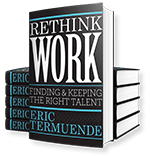
Can be paired with bulk copies of Rethink Work, post-session workshops, or a multi-session leadership program
WHAT THE ROOM SAYS AFTER
“Eric did an excellent job of helping our senior leaders connect the links between strategy and culture with One-Degree Shifts in our thinking about people and process. This slight change in our thinking was a great catalyst for the discussions that followed as we built out our strategies for the coming year.”
DAN KLASSEN, Vice President, Human Resources, Toyota Material Handling
Trusted by leaders at






















Watch Eric
SPEAK
What Prediction Failure
IS ACTUALLY
Costing Organizations
The average cost of replacing a mid-level employee is 1.5 to 2 times their annual salary. Multiply that by the volume of departures happening right now, with 34% of employees actively job-searching, and the cost of failing to build teams resilient enough to retain their best people is not simply an HR metric. It is a business-critical financial exposure.
And the deeper cost is not even financial. It is architectural. Every time a high performer leaves a team that was not resilient enough to keep them, that team becomes fractionally less capable, less trusted, and less psychologically safe. The friction increases. The engagement drops. The next departure becomes more likely. Left unaddressed, the architecture of poor performance becomes self-reinforcing.
Blueprint to the Future breaks that cycle by addressing the architecture directly, not the symptoms.
BLUEPRINT TO THE FUTURE BREAKS THAT CYCLE BY ADDRESSING THE ARCHITECTURE DIRECTLY, NOT THE SYMPTOMS.
Why Current
WORKPLACE
Culture Programs Are Falling Short
Most organizations respond to disengagement, burnout, and retention challenges with programs: leadership development workshops, mental health initiatives, engagement surveys with subsequent action plans, culture transformation projects. Each of these has value. None of them is sufficient on its own. And the reason is not that they are poorly designed.
It is that they treat structural problems as motivational ones. You cannot fix a foundation with a fresh coat of paint. When trust is architecturally low, when the lived experience of leadership does not reliably follow through, communicate honestly, or invest in people as individuals, a trust-building workshop will not fix it. When friction is structurally embedded, when approval chains, unclear ownership, and redundant processes are woven into how the organization operates, a productivity tool will not fix it. When the culture punishes experimentation, when people learn quickly that trying new things and failing is a career risk, an innovation program will not fix it.
BLUEPRINT TO THE FUTURE GIVES LEADERS THE STRUCTURAL DIAGNOSIS AND THE STRUCTURAL PRESCRIPTION: NOT WHAT TO RUN, BUT WHAT TO BUILD.
WHAT HAPPENS IN THE ROOM
BLUEPRINT TO THE FUTURE IS NOT A LECTURE. ERIC OPENS WITH A PROVOCATION THAT IMMEDIATELY REFRAMES THE PROBLEM IN A WAY MOST LEADERS IN THE ROOM HAVE NEVER CONSIDERED.
The research is present throughout: specific, cited, and used to build an argument rather than fill slides. The energy is high, and every session is customized to the specific language and challenges of the audience. The session does not give audiences a view of the horizon. It gives them the tools to build something that holds in any weather.
The most common feedback after a Blueprint to the Future session is not “that was inspiring.” It is “I have never thought about my team’s problems that way before, and I know exactly what to do when I get back to my desk.” That specificity is not accidental. It is the standard the session is built to.
“Stop trying to predict what the future of work looks like. Start building teams that can handle it — whatever it turns out to be. That is the only future-proofing that actually works.”
WHO NEEDS THIS SESSION
MOST
Senior leadership teams who have invested in culture programs that have not moved the engagement needle
CHROs and People leaders who understand the data and are ready to take a different approach to architecture
Conference audiences at moments of significant industry disruption: AI integration, workforce restructuring, generational transitions
Organizations that have experienced recent leadership change or are navigating strategic uncertainty
Any team where the leader suspects the problem is structural but has not had the language to name it
For Meeting Professionals
Frequently asked questions
What is the Blueprint to the Future keynote about?

Blueprint to the Future is a future-of-work and leadership keynote about building a workplace where people can perform at their best as work continues to change.
Eric Termuende explores how trust, unnecessary friction, and experimentation influence workplace culture and team performance. He shows leaders how to create an environment where people can communicate honestly, make decisions more easily, and continuously improve how work gets done.
The keynote provides a practical blueprint for building a stronger organization without relying on perfect predictions about the future of work.
Who is Blueprint to the Future designed for?
Blueprint to the Future is designed for executives, HR leaders, people managers, business owners, operations teams, and organizations preparing for the changing world of work.
It is especially relevant for audiences exploring workplace culture, employee experience, leadership development, engagement, retention, innovation, AI, hybrid work, or the future of their workforce.
The keynote works well for corporate conferences, leadership meetings, HR events, industry associations, management programs, and organizations seeking practical ways to improve how their people work together.
What will leaders learn from Blueprint to the Future?
Leaders learn how to build trust, identify friction, and create a culture of ongoing experimentation.
Eric explains how trust improves communication and gives people the confidence to contribute. He shows how small points of organizational friction can quietly reduce performance, engagement, and momentum. He then demonstrates how small experiments can help teams improve without depending on massive transformation initiatives.
Attendees leave with practical questions and actions they can use to strengthen culture and improve the employee experience.
How does Blueprint to the Future address the future of work and AI?
The keynote helps leaders prepare their organizations for the future of work without attempting to predict every technological or workplace change.
Eric addresses how AI, new employee expectations, changing skill requirements, and faster business cycles are increasing pressure on leaders and teams. Rather than prescribing a single vision of the future, he focuses on the organizational capabilities that remain valuable across different scenarios: trust, communication, low-friction work, experimentation, and continuous learning.
These capabilities help teams respond to new technologies instead of being destabilized by them.
What does reducing friction at work mean?
Reducing friction means identifying and improving the small processes, behaviours, meetings, approvals, communication gaps, and unclear expectations that make it unnecessarily difficult for people to do good work.
Workplace friction can slow decisions, reduce engagement, create frustration, and prevent teams from adapting. Eric helps leaders recognize these obstacles and make targeted improvements rather than relying exclusively on large transformation programs.
Removing even small amounts of friction can give people more time, clarity, energy, and capacity to perform.
How is Blueprint to the Future different from Built for Uncertainty?
Blueprint to the Future focuses broadly on creating a better workplace through trust, reduced friction, and experimentation. Built for Uncertainty focuses specifically on how leaders keep teams aligned and moving when plans and conditions change.
Blueprint to the Future is best suited to conversations about workplace culture, employee experience, future readiness, and improving how work gets done.
Built for Uncertainty is best suited to conversations about uncertainty, adaptability, leadership through change, and maintaining team performance when the path forward is unclear.
Can Blueprint to the Future address our industry’s workforce challenges?
Yes. Eric customizes Blueprint to the Future around the workforce realities of the organization and industry.
The keynote can address challenges such as employee engagement, labour shortages, retention, AI adoption, hybrid work, generational change, operational complexity, leadership development, or evolving customer expectations.
Eric uses research, stakeholder conversations, and industry-specific examples to make the presentation relevant while keeping the central framework focused on trust, friction, and experimentation.